Showing posts with label Toyota 2011. Show all posts

Friday, April 1, 2011

2011 Toyota Cars Reviews

2011 corolla car

2011 Toyota Corolla car interior

Styling studios in Turin, Italy, helped in the creation of changes to the front bumper, radiator grille, front lower grille, headlamps, trunk lid, rear license garnish, rear combination lamp, rear bumper and reflex reflector.
Built on a 102.4-inch wheelbase, the Corolla provides room for five, and its 12.3 cu. ft. trunk rivals midsize cars’ trunks in capacity. The A-pillar was pulled forward and the C-pillar pushed rearward, helping aerodynamics. Engine undercovers improve air management under the car on all models.
Above the dense mesh grille that helps form the now familiar Toyota T-face, an anti-chipping coating prevents damage. The side-view mirrors have increased in size; heated side-view mirrors are available. The S model adds a sporty look while also enhancing aerodynamics with a front spoiler, rocker moldings, and upper and lower rear spoilers.
The A-pillar was specially profiled to cut wind noise; the windshield is made from acoustic glass and the window-frame structure is designed to reduce vibration of side glass. The windshield molding, wiper blade covers and shape of the cowl air intake louvers are all designed to minimize noise (the carpet also provides better insulation). Windshield washer nozzles are partially shielded by the rear edge of the hood, instead of sitting atop the hood or cowling.
A new seat color and pattern enhances Corolla’s contemporary looks, while the combination meter design has been changed to enhance clarity. The instrument panel upper and door trim upper color and steering wheel have been changed.
A standard tilt and telescope steering wheel in all models makes it easy for taller drivers to find a comfortable position. A multi-information display presents a variety of information, including outside temperature, instant fuel economy, average fuel economy, average speed and travel distance.
Careful attention to exhaust system routing provides a nearly flat rear floor, enhancing comfort for the middle passenger. Three interior color schemes are available: Ash, Dark Charcoal and Bisque. The Bisque is paired with Ash Brown trim.
Storage spaces include center console side pockets; a storage box above the usual glove box; front and rear door pockets that can safely hold 20-ounce bottles; a console box with a large-capacity main tray and a smaller accessory tray; an overhead console useful for storage of sunglasses or garage-door openers; and a rear-seat center armrest with an integral drink holder.

Toyota Corolla Powertrain and Suspension

rear 2011 corolla

A four speed automatic transmission is standard on the LE, while a five-speed manual or four-speed automatic are available on other models; the four-speed is electronically controlled, has a flex-lockup torque converter, and has an uphill/downhill shift control in the S position. Gas mileage is rated at 28 city, 35 highway with the manual, and 26 city, 34 highway with the automatic.
The 2.4 liter Camry engine option has been dropped, along with the five speed automatic.
The Toyota Corolla has a stiff body structure thanks to high tensile-strength steel, gussets and cross members. A compact, rigid L-arm-type MacPherson strut front suspension uses a stabilizer bar for stiffness and better cornering. The Corolla’s torsion beam rear suspension employs a coil-over-shock arrangement which balances comfort and performance, in a compact space.
Rear brakes are nine inch drums; front brakes are 10.7 inch vented discs. The Corolla moved to an electric variable power-assist steering system, using a motor, speed reducer, and torque sensor built into the steering column. Electric power steering reduces parasitic losses to the engine, thereby aiding fuel economy; it does not require oil; and it makes a future hybrid option easier to engineer.

2011 Toyota Corolla Reviews

Corolla-rear

2011 Toyota Corolla

The Toyota Corolla, the perennial best selling subcompact in America and the world’s best selling car (in total), has been refreshed for the 2011 model year, with a new front and rear appearance, standard stability and traction control, and a free maintenance plan.
Unveiled at the Los Angeles Auto show on November 16, 2010, the 2011 Toyota Corolla was slated for sale in December 2010. It continued to have standard stability control, traction control, antilock brakes, electronic brake force distribution, and emergency brake assist. New is a system used by most other major automakers for years, a brake override which cuts the throttle when the brakes are used.
Three trim levels are sold, the un-named base model, the Corolla LE, and Corolla S; all use the same engine, the new-for-2008 1.8 liter dual cam four cylinder, which pushes out 132 hp at 6,000 rpm and 128 lb-ft of torque at 4,400 rpm (coincidentally, almost identical to the 2.0 liter 1995 Neon). Dual Variable Valve Timing with intelligence (VVT-i) controls valve timing on both the intake and exhaust camshafts to optimize efficiency, and further steps were taken to cut friction within the engine.

Wednesday, March 2, 2011

Toyota FT-86 Concept Reviews


The concept car Toyota FT-86 (that’s hachi roku in Japanese) goes back to the fundamental qualities of the classic sports car with its rear-wheel drive configuration, compact dimensions, low centre of gravity and lightweight construction. Under the bonnet there is a 2.0-litre boxer engine that is strong on both performance and environmental quality
Great to own and fun-to-drive: those are the guiding principles behind a new Toyota sports car concept that will break cover for the first time at the Tokyo motor show later this month.
The show car’s bodywork is finished in Flash Red, an eye-catching shade that contains a hint of blue. Inside, the cabin design further expresses the car’s classic sporting qualities with many of the structural elements left uncovered.

2011 Toyota Hybrid X concept car

Toyota Hybrid X concept car

Toyota will provide a vision for the future of hybrid cars when it unveils the Hybrid X concept car at this year’s Australian International Motor Show.
Hybrid X proposes a new design language for Toyota’s hybrid models while also acting as a technology showcase for future hybrid cars.
Created and developed by Toyota’s European styling centre ED² in the south of France, Hybrid X is a four-door, four-seat concept that is spacious and comfortable.It is a step closer to Toyota’s vision of the ultimate environmental driving technology.
Its design will influence the entire Toyota brand and its hybrid models in the future.A vision for future environmentally friendly motoring, the appearance of Hybrid X comes soon after Toyota announced it would build a hybrid Camry in Australia from 2010.
Hybrid X is the latest concept to demonstrate Toyota’s world-leading Hybrid Synergy Drive® technology, which is at the core of the company’s strategy to develop the ultimate eco-car.


The show car fits clearly within Toyota’s environmental strategy of offering sustainable mobility for modern families.
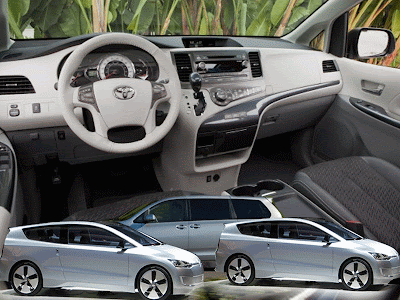
It has the dimensions of a conventional family car with an overall length of 4,500mm and wheelbase of 2,800mm. The width is 1,850mm and height 1,440mm.
It proposes unconventional creative solutions that will potentially become the signature points of a specific hybrid identity.
Hybrid X features a futuristic body shape that is dominated by two ‘U’ shapes created by the upper glass frame area and the unconventional A and C pillars.
Viewed from above, this gives the impression of a large X – hence the name of the concept, Hybrid X.
Dynamic hints of driving performance are provided by the customised 20-inch alloy wheels with ultra-low profile 225/40 R20 tyres.
LED headlamps are integrated into the dashboard and are now part of the interior of the car and can communicate information such as safety distances, acceleration and braking to other drivers and pedestrians.
The driver can set the ambience within the car, controlling sight, sound, touch and even smell.
A drive-by-wire steering pad features a central screen to relay information to the driver about the energy flow path, fuel consumption and gear position.
Space-saving seats are formed using injected foam techniques, which create comfort while reducing weight.
The two independent rear seats can swivel by 12 degrees to allow passengers to enjoy the scenery or conversation

TOYOTA CARS THIRD GENERATION SIENNA MINIVAN REVIEWS


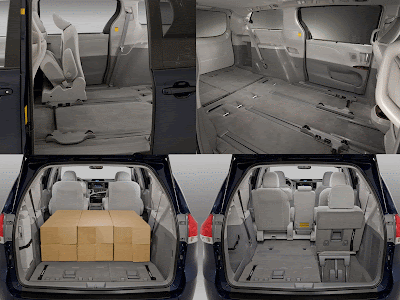
Toyota is the first carmaker in North America to be offering this innovation. The Auto Access Seat has a seat-mounted ingress/egress switch and a wireless remote control that allows for easy and flexible seat operation. The seat is able to rotate 90 degrees and can be lowered to within 19 inches of the ground to further facilitate easier passenger transfers at the exact height required. The Toyota Sienna is well known as a transportation solution for moving people and cargo comfortably and efficiently. The third-generation Toyota Sienna will look and drive more like a sedan, conform to new ideas about personal comfort, easily accommodate cargo, and handle big loads. The Toyota Sienna will come in five conveniently configured grades, all sharing a distinctly new visual direction and features. Toyota unveiled the all-new, third-generation Toyota Sienna minivan at a media conference at the 2009 Los Angeles Auto show.
Third-Generation Toyota Sienna Minivan

The 2011 Sienna has been reinvented to handle these needs as it shifts to a more expressive and dynamic vehicle with a stronger profile, high shoulder character and responsive handling. The 2011 Toyota Sienna may be the Japanese automaker's third-generation minivan, but Toyota emphasizes that the new Sienna is becoming more carlike than ever. The Sienna gets smart updates to its drivetrains and to its interior package for 2011-but not to its seating configurations, which still lag the class-leading Dodge Grand Caravan and Nissan Quest in flexibility. The Sienna is offered in a broad model range, and continues to be the only minivan with an all-wheel-drive option.
Third-Generation Toyota Sienna Minivan

The third-generation Sienna combines a contemporary style with features not previously seen in a minivan, and a fun-to-drive spirit that will surprise many, along with the flexibility, spaciousness and features that have defined the segment. The Sienna was designed by Toyota's Calty Design Research and developed at Toyota Technical Center in Ann Arbor, Mich., with assembly being accomplished at Toyota Motor Manufacturing, Indiana.
Third-Generation Toyota Sienna Minivan

A Toyota first rear-seat Dual View Entertainment Center is another innovative option. The system uses two displays side-by-side to create a seamless 16.4-inch widescreen image from a single source. When two separate entertainment options are called for, the system can split the screen into two individual screens, each with input from separate sources. Used as a single screen, it can be easily seen from the third row, and it can be operated from any seat via remote control. Used as two screens, the system can accommodate the preferences of two separate passengers who might want to play a video game or watch a second DVD simultaneously via auxiliary inputs.
Third-Generation Toyota Sienna Minivan

A choice of two responsive DOHC engines will be available: a 3.5-liter V6 or 2.7-liter four-cylinder engine. By adding the alternative of a four-cylinder engine, the 2011 Toyota Sienna is the first minivan in years to stray from the V-6-engine-only formula. Both engines offer the latest in efficient, lightweight technology, including Dual Variable Valve Timing with intelligence (VVT-i), roller rocker arms and an Acoustically Controlled Induction System (ACIS) that changes the length of the air-intake pipe to supply more torque on demand.
Third-Generation Toyota Sienna Minivan

The 3.5-liter V6 makes 266 horsepower at 6,200 rpm, with expected EPA-estimated mileage ratings of 18 mpg city/24 mpg highway (16 mpg city/22 mpg highway on AWD models). It also has a 3,500-pound tow capacity. With 187 horsepower at 5,800 rpm, the 2.7-liter four-cylinder engine produces responsive power that exceeds some competitors V6 performance, while delivering expected EPA-estimated fuel efficiency ratings of 19 mpg city and 26 mpg on the highway. Given its upgraded engineering, every Toyota Sienna will ride well and track cleanly through corners, but none more so than the newest addition to the line: the sporty SE.
Third-Generation Toyota Sienna Minivan

The Limited is designed for customers who want all the features with more luxury. The standard equipment list is extensive, including new second-row Lounge Seating and a power 60/40 Split & Stow third-row seat, front and rear parking sonar, dual moonroof, Smart Key, and Safety Connect™. Select options include those available on the XLE plus HID auto high-beam auto-high beam headlamps, rain-sensing wipers, and Pre-Collision System (PCS) with Dynamic Radar Cruise Control.
Third-Generation Toyota Sienna Minivan

The Toyota Sienna will come in five grades: Sienna grade, LE, SE, XLE and Limited. All-wheel-drive is available with the V6 on LE, XLE and Limited models. The all-new 2011 Toyota Sienna will begin arriving at Toyota dealerships in February 2010.

THIRD GERERATION TOYOTA SIENNA MINIVAN CARS

Toyota is the first carmaker in North America to be offering this innovation. The Auto Access Seat has a seat-mounted ingress/egress switch and a wireless remote control that allows for easy and flexible seat operation. The seat is able to rotate 90 degrees and can be lowered to within 19 inches of the ground to further facilitate easier passenger transfers at the exact height required. The Toyota Sienna is well known as a transportation solution for moving people and cargo comfortably and efficiently. The third-generation Toyota Sienna will look and drive more like a sedan, conform to new ideas about personal comfort, easily accommodate cargo, and handle big loads. The Toyota Sienna will come in five conveniently configured grades, all sharing a distinctly new visual direction and features. Toyota unveiled the all-new, third-generation Toyota Sienna minivan at a media conference at the 2009 Los Angeles Auto show.
2011 Third-generation Toyota Sienna Minivan

The 2011 Sienna has been reinvented to handle these needs as it shifts to a more expressive and dynamic vehicle with a stronger profile, high shoulder character and responsive handling. The 2011 Toyota Sienna may be the Japanese automaker's third-generation minivan, but Toyota emphasizes that the new Sienna is becoming more carlike than ever. The Sienna gets smart updates to its drivetrains and to its interior package for 2011-but not to its seating configurations, which still lag the class-leading Dodge Grand Caravan and Nissan Quest in flexibility. The Sienna is offered in a broad model range, and continues to be the only minivan with an all-wheel-drive option.
2011 Third-generation Toyota Sienna Minivan

The third-generation Sienna combines a contemporary style with features not previously seen in a minivan, and a fun-to-drive spirit that will surprise many, along with the flexibility, spaciousness and features that have defined the segment. The Sienna was designed by Toyota's Calty Design Research and developed at Toyota Technical Center in Ann Arbor, Mich., with assembly being accomplished at Toyota Motor Manufacturing, Indiana.
2011 Third-generation Toyota Sienna Minivan

A Toyota first rear-seat Dual View Entertainment Center is another innovative option. The system uses two displays side-by-side to create a seamless 16.4-inch widescreen image from a single source. When two separate entertainment options are called for, the system can split the screen into two individual screens, each with input from separate sources. Used as a single screen, it can be easily seen from the third row, and it can be operated from any seat via remote control. Used as two screens, the system can accommodate the preferences of two separate passengers who might want to play a video game or watch a second DVD simultaneously via auxiliary inputs.

2011 TOYOTA CARS THIRD GENERATION REVIEWS


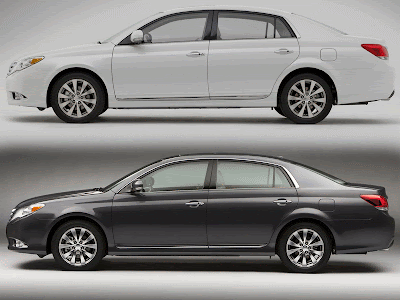
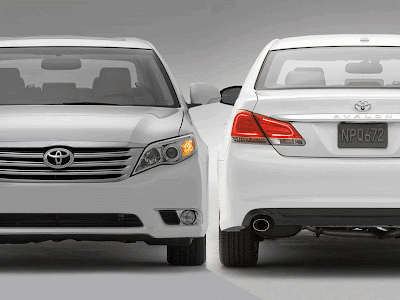
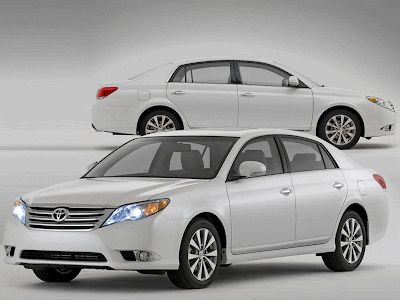
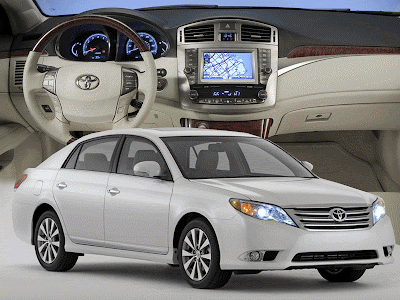
Evoking a time when travel was sophisticated, elegant and comfortable, the new Toyota Avalon possesses a distinctive new exterior style while offering a restyled interior rich with premium touch points and practical new technologies. Toyota introduced the boldly redesigned 2011 Toyota Avalon at the 2010 Chicago Auto Show. The third generation Toyota Avalon was introduced in four models: the standard XL, the sport Touring, the XLS, and the luxury Limited. Each combined generous interior room with powerful engine performance.
Redesigned Toyota Avalon Third Generation
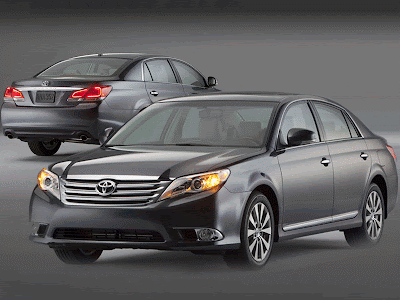
Designed at Toyota’s Calty Design Research in California, and assembled at Toyota’s Georgetown Kentucky manufacturing plant, the third-generation Avalons all have front grilles with horizontal chrome bars, large tail lamps, distinctive trunks, and dual exhaust outlets.
Even with numerous refinements inside and out, the Toyota Avalon remains true to the idea that comfort is honest and uncomplicated, and "Traveling Avalon Class" is rich in simple, familiar pleasures.
Redesigned Toyota Avalon Third Generation
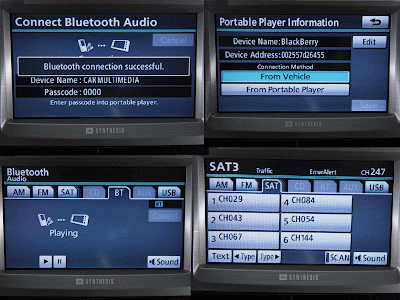
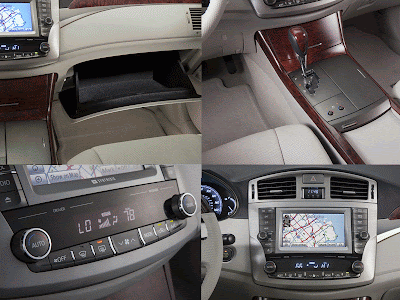
The new Toyota Avalon has dynamic and expressive lines, and an infusion of comfort, safety and technology advancements that enrich the driving experience. Upgraded equipment and technology features, such as a touch-screen navigation system with real-time traffic, and Bluetooth® hands-free phone capability with music streaming to the audio system are among the improvements that enhance the 2011 Avalon's excellent blend of spaciousness, comfort and technology.
Redesigned Toyota Avalon Third Generation
"The Toyota Avalon has long been appreciated by smart, conscientious consumers who recognize quality materials and the beauty of detailed craftsmanship," said Bob Carter, group vice president and general manager, Toyota Division, Toyota Motor Sales, U.S.A. "The changes made for 2011 will allow us to build on our position in the premium large car segment. The competition does not stand still, and neither do we."
Redesigned Toyota Avalon Third Generation
Restyled at Calty Design Research in Newport Beach, Calif., the Toyota Avalon is assembled at Toyota Motor Manufacturing Kentucky (TMMK), a "zero landfill" facility that also assembles the Camry, Camry Hybrid, and Venza. It was also developed at the Toyota Technical Center (TTC) in Ann Arbor, Mich. For 2011, Calty restyled Toyota Avalon to project an elegant, outgoing presence. A wider, more substantial grille ties into state-of-the-art projector headlamps, working with a broad, undisturbed front hood to suggest a lowered center of gravity and emphasize the Toyota Avalon's wide stance.

2011 Third-generation Toyota Sienna Minivan

2011 Third-generation Toyota Sienna Minivan

A choice of two responsive DOHC engines will be available: a 3.5-liter V6 or 2.7-liter four-cylinder engine. By adding the alternative of a four-cylinder engine, the 2011 Toyota Sienna is the first minivan in years to stray from the V-6-engine-only formula. Both engines offer the latest in efficient, lightweight technology, including Dual Variable Valve Timing with intelligence (VVT-i), roller rocker arms and an Acoustically Controlled Induction System (ACIS) that changes the length of the air-intake pipe to supply more torque on demand. 
2011 Third-generation Toyota Sienna Minivan

The 3.5-liter V6 makes 266 horsepower at 6,200 rpm, with expected EPA-estimated mileage ratings of 18 mpg city/24 mpg highway (16 mpg city/22 mpg highway on AWD models). It also has a 3,500-pound tow capacity. With 187 horsepower at 5,800 rpm, the 2.7-liter four-cylinder engine produces responsive power that exceeds some competitors V6 performance, while delivering expected EPA-estimated fuel efficiency ratings of 19 mpg city and 26 mpg on the highway. Given its upgraded engineering, every Toyota Sienna will ride well and track cleanly through corners, but none more so than the newest addition to the line: the sporty SE.
2011 Third-generation Toyota Sienna Minivan

The Limited is designed for customers who want all the features with more luxury. The standard equipment list is extensive, including new second-row Lounge Seating and a power 60/40 Split & Stow third-row seat, front and rear parking sonar, dual moonroof, Smart Key, and Safety Connect™. Select options include those available on the XLE plus HID auto high-beam auto-high beam headlamps, rain-sensing wipers, and Pre-Collision System (PCS) with Dynamic Radar Cruise Control.


The Toyota Sienna will come in five grades: Sienna grade, LE, SE, XLE and Limited. All-wheel-drive is available with the V6 on LE, XLE and Limited models. The all-new 2011 Toyota Sienna will begin arriving at Toyota dealerships in February 2010.

Redesigned Toyota Avalon Third Generation Cars

Redesigned Toyota Avalon Third Generation
A power rear sunshade, deployable via a one-touch lever, filters direct sunlight coming through the rear window. The sunshade, which helps to protect rear seat passengers from unwanted light and heat, automatically detracts when the driver selects reverse gear. Toyota Avalon's exceptional combination of ample horsepower and excellent fuel economy offers one of the best overall dynamic performances in the large sedan segment.
Redesigned Toyota Avalon Third Generation
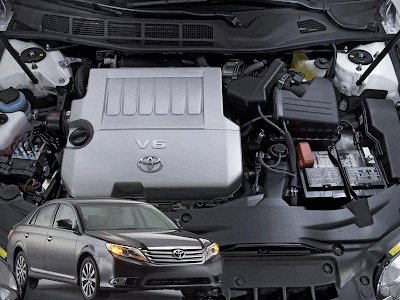
The 2011 Avalon is powered by a 24-valve, dual-overhead cam 3.5-liter V6 engine that produces 268 horsepower at 6,200 rpm. The engine is equipped with the latest dual VVT-i electronic valve-control mechanism that provides a broader powerband, while requiring less fuel and generating fewer emissions. It is mated to a multi-mode six-speed automatic transmission. The 2011 Toyota Avalon is an Ultra Low Emission Vehicle (ULEV), EPA-estimated to deliver 20 mpg in the city, 29 highway, and 23 combined, as good as or better than any V6 model in the segment.

The 2011 Toyota Avalon will be available in two grades when it arrives in showrooms in the spring of 2010, Avalon and Limited. Both grades will be well equipped with standard equipment like eight-way leather-trimmed power driver's seats, back-up camera, dual zone automatic climate control with air filtration, moonroof and 17-inch alloy wheels. Toyota Avalon will be available in nine exterior colors including three new colors: Zephyr Blue Metallic, Cypress Pearl and Sizzling Crimson Mica.

2011TOYOTA CARS REVIEWS

Evoking a time when travel was sophisticated, elegant and comfortable, the new Toyota Avalon possesses a distinctive new exterior style while offering a restyled interior rich with premium touch points and practical new technologies. Toyota introduced the boldly redesigned 2011 Toyota Avalon at the 2010 Chicago Auto Show. The third generation Toyota Avalon was introduced in four models: the standard XL, the sport Touring, the XLS, and the luxury Limited. Each combined generous interior room with powerful engine performance. 

Designed at Toyota’s Calty Design Research in California, and assembled at Toyota’s Georgetown Kentucky manufacturing plant, the third-generation Avalons all have front grilles with horizontal chrome bars, large tail lamps, distinctive trunks, and dual exhaust outlets.
Even with numerous refinements inside and out, the Toyota Avalon remains true to the idea that comfort is honest and uncomplicated, and "Traveling Avalon Class" is rich in simple, familiar pleasures.

The new Toyota Avalon has dynamic and expressive lines, and an infusion of comfort, safety and technology advancements that enrich the driving experience. Upgraded equipment and technology features, such as a touch-screen navigation system with real-time traffic, and Bluetooth® hands-free phone capability with music streaming to the audio system are among the improvements that enhance the 2011 Avalon's excellent blend of spaciousness, comfort and technology.

"The Toyota Avalon has long been appreciated by smart, conscientious consumers who recognize quality materials and the beauty of detailed craftsmanship," said Bob Carter, group vice president and general manager, Toyota Division, Toyota Motor Sales, U.S.A. "The changes made for 2011 will allow us to build on our position in the premium large car segment. The competition does not stand still, and neither do we."
  
Restyled at Calty Design Research in Newport Beach, Calif., the Toyota Avalon is assembled at Toyota Motor Manufacturing Kentucky (TMMK), a "zero landfill" facility that also assembles the Camry, Camry Hybrid, and Venza. It was also developed at the Toyota Technical Center (TTC) in Ann Arbor, Mich. For 2011, Calty restyled Toyota Avalon to project an elegant, outgoing presence. A wider, more substantial grille ties into state-of-the-art projector headlamps, working with a broad, undisturbed front hood to suggest a lowered center of gravity and emphasize the Toyota Avalon's wide stance.

2011 Redesigned Toyota Avalon Third Generation Cars

2011 Redesigned Toyota Avalon Third Generation 
A power rear sunshade, deployable via a one-touch lever, filters direct sunlight coming through the rear window. The sunshade, which helps to protect rear seat passengers from unwanted light and heat, automatically detracts when the driver selects reverse gear. Toyota Avalon's exceptional combination of ample horsepower and excellent fuel economy offers one of the best overall dynamic performances in the large sedan segment.
2011 Redesigned Toyota Avalon Third Generation 
The 2011 Avalon is powered by a 24-valve, dual-overhead cam 3.5-liter V6 engine that produces 268 horsepower at 6,200 rpm. The engine is equipped with the latest dual VVT-i electronic valve-control mechanism that provides a broader powerband, while requiring less fuel and generating fewer emissions. It is mated to a multi-mode six-speed automatic transmission. The 2011 Toyota Avalon is an Ultra Low Emission Vehicle (ULEV), EPA-estimated to deliver 20 mpg in the city, 29 highway, and 23 combined, as good as or better than any V6 model in the segment.

The 2011 Toyota Avalon will be available in two grades when it arrives in showrooms in the spring of 2010, Avalon and Limited. Both grades will be well equipped with standard equipment like eight-way leather-trimmed power driver's seats, back-up camera, dual zone automatic climate control with air filtration, moonroof and 17-inch alloy wheels. Toyota Avalon will be available in nine exterior colors including three new colors: Zephyr Blue Metallic, Cypress Pearl and Sizzling Crimson Mica.

Saturday, February 26, 2011

Hot video Toyota iQ

Toyota has updated the popular SUV Land Cruiser Prado

Toyota Land Cruiser Prado

More than a year, fans enjoy the new generation Toyota giant Land Cruiser. 200-I model has caused a great revival among the lovers of the brand.

Meanwhile, fans of a more compact version of Land Cruiser - Prado - remained dissatisfied. Their car is produced without major changes since 2002.

Now came their turn - new arrive on sale as early as next year. The appearance of the car, as is the case with 200-first model, to declassify the Arab fans of the brand. Photos of cars appeared on the eve of an Arab sites.

Toyota Land Cruiser Prado

Unfortunately, the Internet only got photos of front and rear parts, so difficult to say whether the profile of the car.

Toyota Land Cruiser Prado

What engines will be installed on a new generation of automobiles, still unknown. According to rumors, in the beginning it will be old engines: gasoline 4.0-liter V6 power of 249 liters. with. and 3.0-liter turbo-diesel engine with 173 «horse».

2011 Toyota FT-86G Sports Concept

The Toyota FT-86G Sports Concept named is derived from the AE-86 Corolla – a small, light-weight, rear-wheel drive coupe from the 1980s that has achieved cult status. The “G” suffix signifies a sports conversion that has stretched the original by 30mm, widened it by 20mm and lowered it by 30mm (4190mm × 1780mm × 1230mm).
Sharper looks come from a totally redesigned front end that incorporates a larger air intake with visible intercooler, as well as a vented bonnet. At the rear, a large carbon-fibre wing, diffuser and oversized twin exhausts contribute to the edgier styling. The Toyota FT-86G Sports Concept sits on low-profile Bridgestone 19-inch rubber – 245/40 at the front and 275/35 at the rear, while Recaro sports seats complete the “G” conversion of the dynamic four-seater.
The concept retains classic sports-car underpinnings with a front-mounted 2.0-litre engine – now boosted with a turbo – driving the rear wheels through a six-speed manual transmission.

Toyota promises to make the maximum availablehydrogen-mobilized

Toyota_logo
Toyota Monogram

At the time of entering the market, the cost of such a car would be a record low, despite the newness of technology.

Toyota Motor has distributed an update on the development of own cars on fuel cells or hydrogen-mobilized. The company expects that their value at the time of entering the market will be «shocking low». Will take into account the experience of hybrids, which were initially very expensive, that do not attract more buyers. Hybrids more expensive than gasoline counterparts, and now, but their popularity is growing all the same. Even more successful Toyota intends to achieve by submitting hydrogen-mobilized (or several models), who accessibility could compete with gasoline, while possessing a number of significant advantages, especially in terms of efficiency and environmental friendliness.
Toyota is pleased with the progress which has already been achieved and the level of developed technologies. In 2015, hydrogen-mobilized come on the market, allegedly, regardless of whether sufficient infrastructure for maintenance and refueling or not. At this time, Japanese automakers are concerned, how consumers will view a new type of car. A kind of marketing should be the prototype Plug-In hybrids, including a special version of Prius.
Serial hydrogen-mobilized Toyota will be developed based on technologies that continue to improve on the prototype FCHV. It was built on the base model Toyota Highlander / Kluger, but this does not mean the company stresses that the first production fuel cell car will be exactly Highlander. Most likely it will be much more compact model.
It should be noted that only Japanese hydrogen-mobilized in the market, is the Honda FCX Clarity, available in Japan and the United States in a kind of rent-lease. Buy a model could be, and his rent, for example, in California, the U.S. will cost $ 600 a month.

Global production at Toyota factories fell

Toyota Prius 2007
Toyota Cars


Global production at factories in the world's largest automotive company Toyota Motor Corp. in May 2009 decreased by 38.8 percent compared to the situation a year ago. The volume of production it falls now in its tenth month in succession, said the report was circulated today, the corporation.

In May, sales at avtogiganta fell worldwide by 28 percent, and within Japan itself - only for 23,1 percent. This is due to strong demand in the country for a new model of hybrid gasoline-electric vehicle Prius. Only one month it was 180 thousand jobs.

The report notes that, in a generally unfavorable market conditions have some signs of improvement in the market. Within Japan it is connected, in particular, with the subsidies that the government started to issue citizens buying cars with high fuel economy type Prius